My first engineering challenge at MAUI Day Skopje 2026 arrived before I had even entered the conference room.
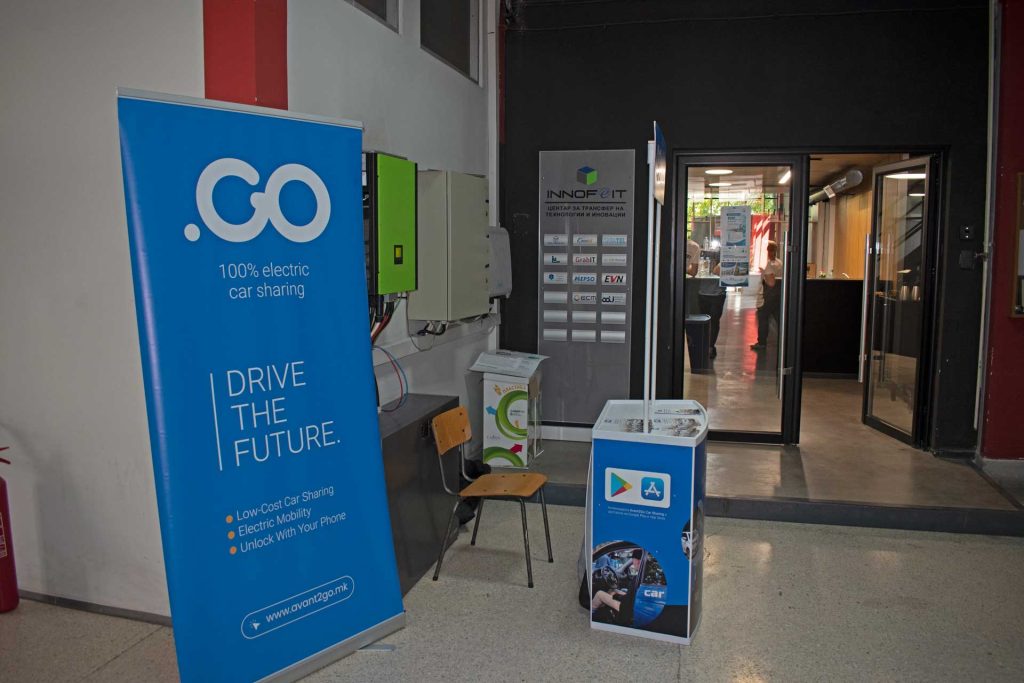
When I walked into INNOFEIT on the Technical Campus in Skopje on September 17, Tony Edwards approached me with a smile and asked whether I was there for .NET MAUI Day. After I confirmed, he handed me what was effectively a tiny assembly task: put my name card into the plastic conference badge holder and attach it to the lanyard.
I told him that might already be too complex an engineering task for me. It was a good way to start the morning.
A few moments later, Vlatko Tasevski approached me, introduced himself, and started asking about my work and what had brought me to the event. He also told me a little about how MAUI Day, an international event format dedicated to .NET MAUI, had made its way to Skopje. His excitement was obvious. So was his pride in seeing the local .NET community host it. He had every reason to be proud, as did the other parties involved in making this event happen.
MAUI Day is a one-day, in-person event focused on cross-platform application development with .NET MAUI. The Skopje edition was part of the wider WhatTheStack 2026 conference week, which ran from September 14 to 19 and included workshops, DevFest, Angular Day, MAUI Day, and the main Saturday conference. The official WhatTheStack program describes the week as six days of software-focused community events, with MAUI Day taking place at INNOFEIT on September 17.
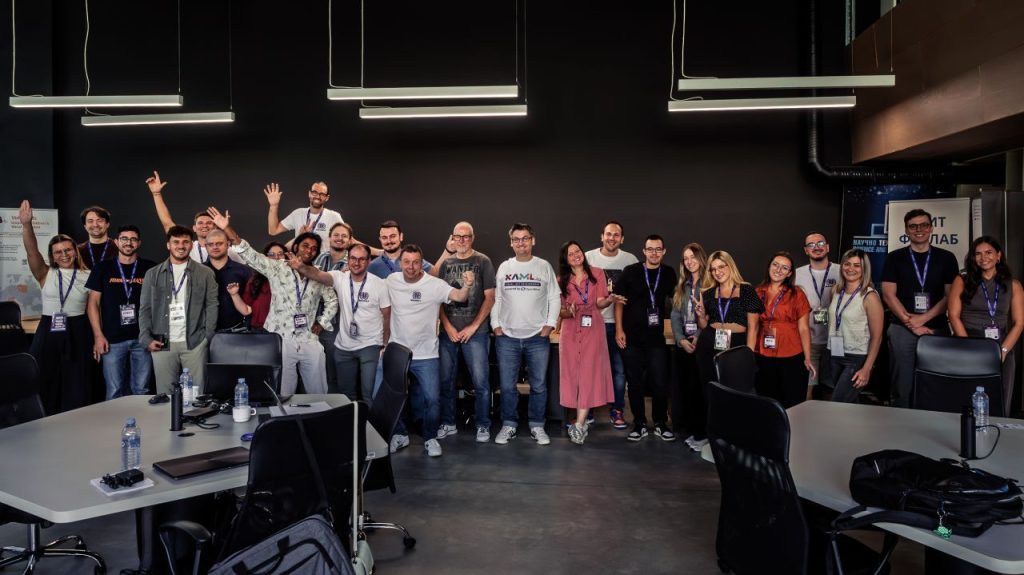
Yet despite being connected to a much larger conference, MAUI Day itself felt almost unusually intimate. There were perhaps twenty or thirty of us in the room. And that turned out to be one of its greatest strengths.
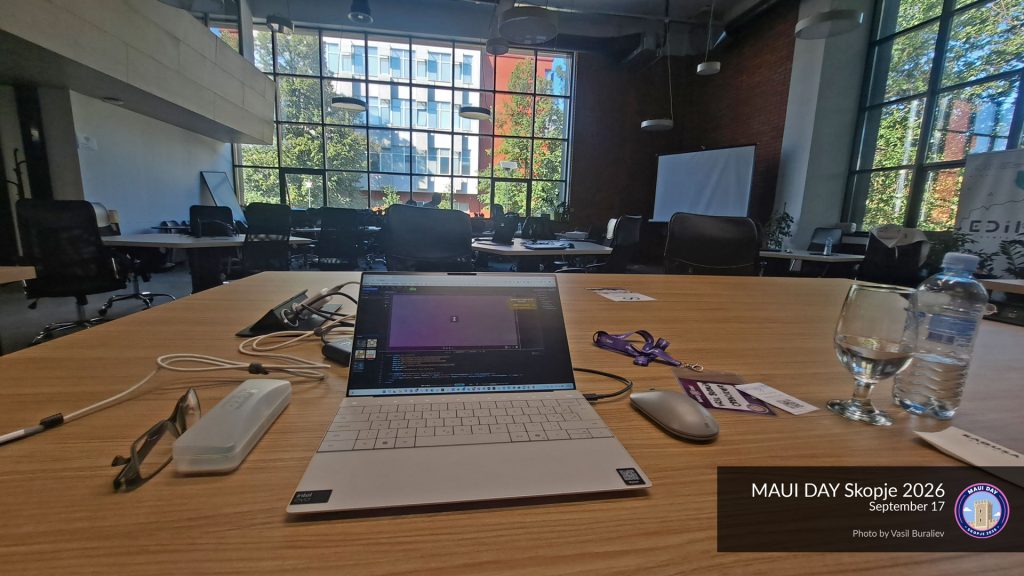
I Wasn’t There Because I Planned to Become a MAUI Developer
My own reason for attending was slightly unusual.
I have spent much of my professional life working with Microsoft technologies: ASP Classic, .NET Framework, C#, ASP.NET, MS SQL, software architecture, and business application development. But I am not a .NET MAUI developer, and I did not go to MAUI Day because I was planning my next native MAUI application.
I went primarily because of OpenSilver.
I am involved with Userware, the company behind OpenSilver and XAML.io, and OpenSilver’s ecosystem increasingly intersects with .NET MAUI Hybrid. That made me curious about the platform itself: not only what .NET MAUI can do today, but where Microsoft and the community are taking it next.
That curiosity turned out to be well rewarded.
Before the sessions started, I explained some of that background to Vlatko over coffee. Shortly afterward, I met Ilija Rushkovski, another member of the local community. Our conversation quickly moved beyond MAUI itself. After he mentioned working remotely for a company in California, we ended up talking about freelancing and distributed work, and I shared a little from my own roughly ten years of professional freelancing.
Those small conversations became more important to my experience of the day than I initially expected.
A Small Room, With Very Little Distance Between Attendees and Speakers
In technology, we tend to associate significance with scale. Big conference. Big stage. Thousands of attendees. Big sponsor area. Big keynote. MAUI Day Skopje reminded me that professional value does not necessarily scale that way.
The official MAUI Day concept emphasizes not just sessions, but workshops, community, and what it calls “hallway-track conversations.” In Skopje, that idea became very literal. There was almost no meaningful physical distance between attendees and people who work directly on technologies developers around the world use every day.
Among the speakers were Gerald Versluis, a Microsoft engineer heavily involved in .NET MAUI and one of its most visible community educators, and Stéphane Delcroix, who has worked on Xamarin.Forms and .NET MAUI since 2013 and has been part of the Mono and .NET ecosystem since 2005.
At a conference with several thousand people, those names might appear twenty meters away on a stage. Here, they were simply in the room.
That made MAUI Day feel like one of those small technology events that can easily pass unnoticed outside the immediate community, while offering unusually direct access to the people shaping the tools themselves. A hidden gem, in other words.
Gerald Versluis: From What MAUI Is to Where Development May Be Going
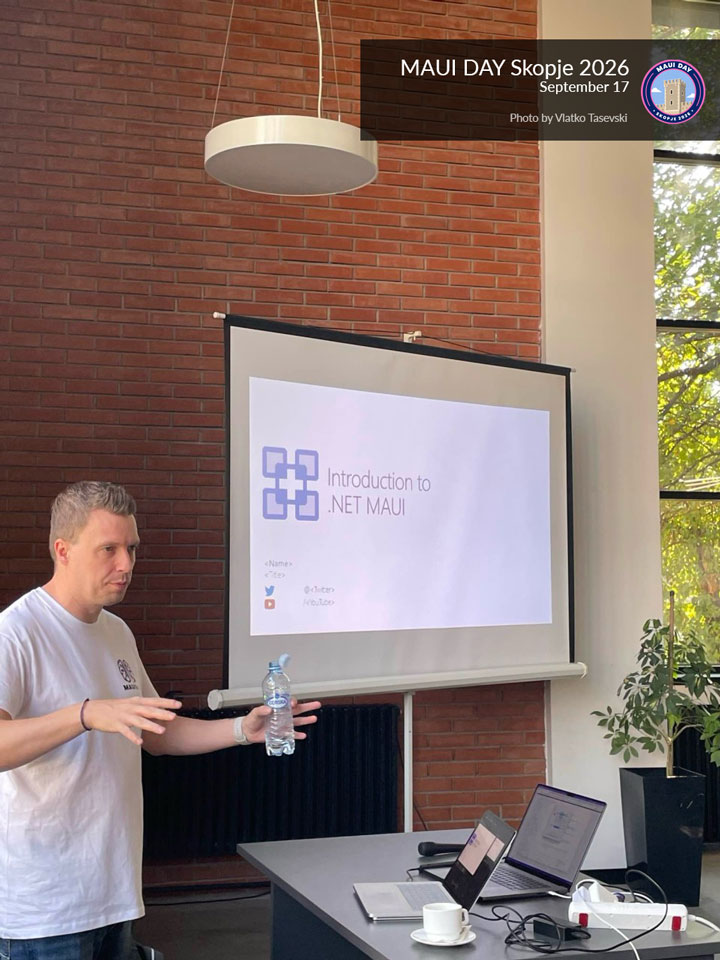
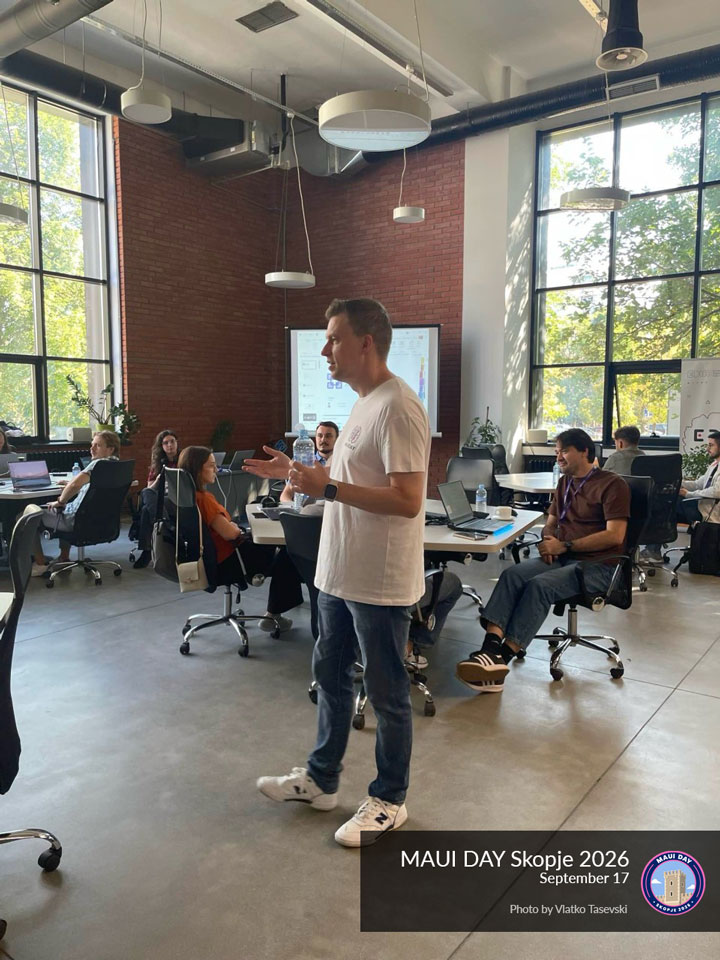
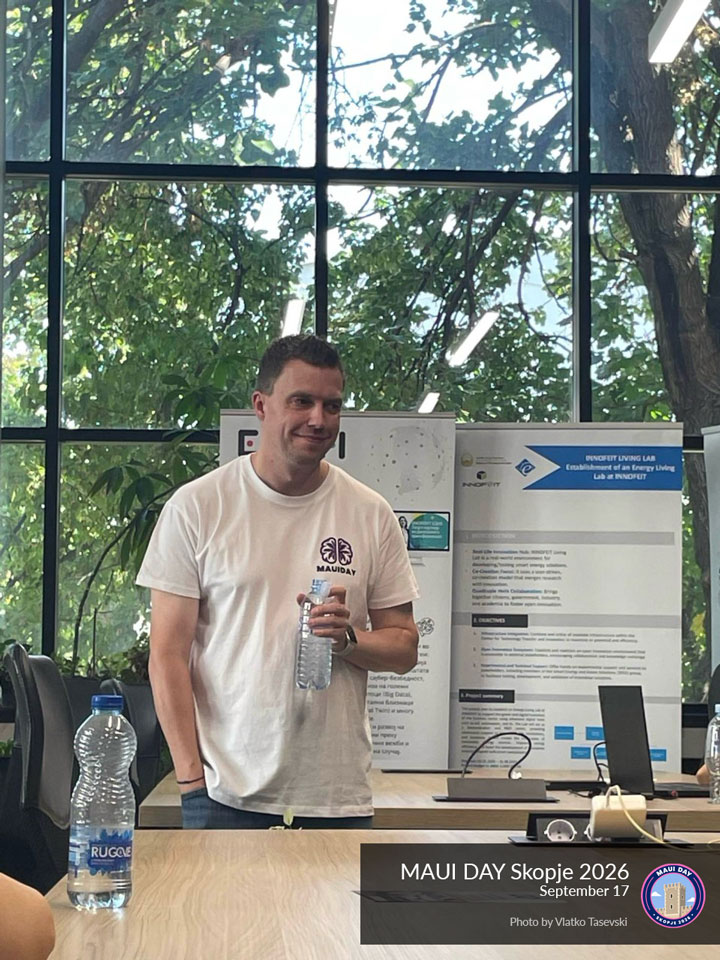
Gerald appeared three times during the day, and I found the progression between his sessions particularly interesting.
The first established the fundamentals and the role of .NET MAUI as Microsoft’s cross-platform application framework. The second moved toward what is changing in the upcoming .NET 11 generation of MAUI. Microsoft currently describes quality improvement as a central theme of .NET MAUI in .NET 11, alongside changes in runtime behavior, tooling, testing, XAML, platform support, and developer workflows. But for me, Gerald’s final appearance was the most thought-provoking.
The subject had shifted from a framework to the act of software development itself.
He discussed AI-assisted engineering and tools such as DevFlow, part of the experimental MAUI Labs work. DevFlow can expose a running MAUI application to tooling that can inspect its visual tree, capture screenshots, observe the application, and—with an MCP server—allow AI agents to interact programmatically with the running software. Gerald has described this publicly as giving coding agents the ability to “see and touch” a MAUI app rather than merely generate source code and hope that the result is correct.
I had not been aware of the tool before the event. That idea immediately caught my attention.
The interesting part isn’t simply that AI can write more code (Dr. Jekyll) and test that code (Mr. Hyde). We already know that. The more important question is what happens when an agent can participate in a much richer engineering loop:
build > run > inspect > identify a problem > modify > verify.
That starts looking considerably different from autocomplete.
XAML in .NET 11: The Feedback Loop Gets Shorter
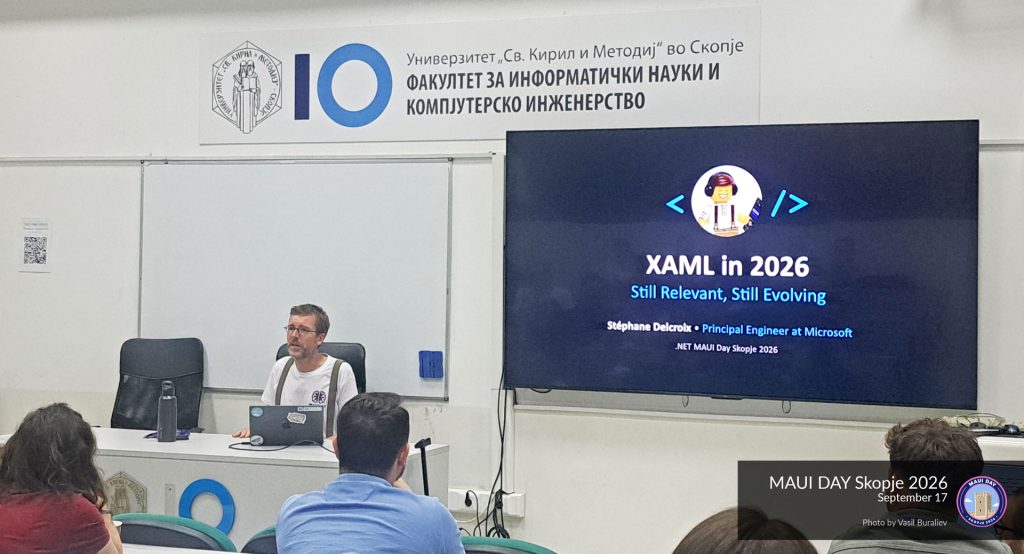
Stéphane Delcroix’s session, “XAML in 2026, Still Relevant, Still Evolving,” approached developer productivity from a different angle.
The upcoming XAML work includes global and implicit XML namespaces, source generation, C# expressions in XAML, performance improvements, and a new Incremental Hot Reload engine.
Of those, Incremental Hot Reload is perhaps the improvement that interests me most.
Starting with .NET MAUI 11 Preview 7, supported XAML changes can be converted into patches and applied to live instances of already-created pages and controls. Developers can modify properties, bindings, page resources, or elements in parts of the visual tree without necessarily rebuilding, redeploying, or navigating away from the page and back again.
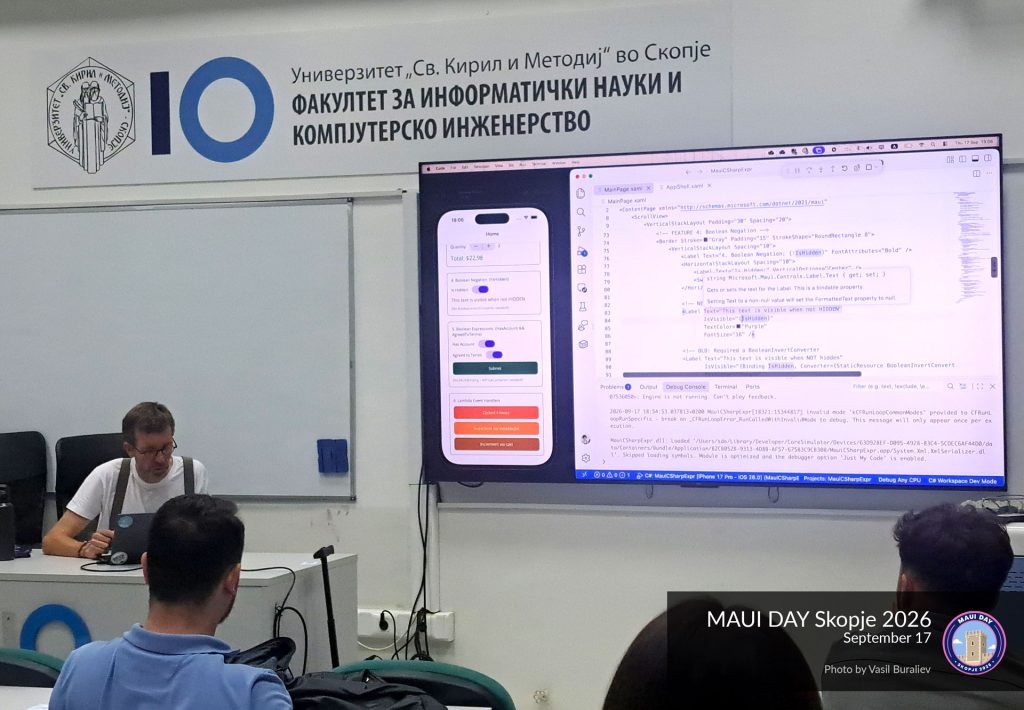
At first glance, Hot Reload may sound like a convenience feature. But developer productivity often depends on feedback loops. Change something. Wait. Run it. Navigate back to the right state. Observe the result. Discover that something is wrong. Repeat.
Every reduction in that loop matters.
And looking back at Stéphane’s presentation together with Gerald’s AI discussion, I realized there was a common theme running through both. Stéphane was talking about shortening the human developer’s feedback loop. Gerald was showing a direction in which an AI agent can begin participating in that same loop.
That connection may ultimately be more important than any individual MAUI feature.
This Felt Familiar From My Own AI-First Development Work
Gerald’s session particularly resonated with me because I have been experimenting with a similar shift in engineering responsibilities in my own work.
On a current software project, I have been using an AI-first development process where much more of my time goes into defining the system than manually implementing every piece of it: architecture, domain rules, specifications, constraints, boundaries, acceptance criteria, and instructions an AI agent can execute against.
The code still matters. But the scarce engineering resource increasingly becomes judgment.
What exactly are we trying to build? Which architectural boundaries must not be violated? What does “done” actually mean? What evidence tells us the implementation is correct? Which compromises are acceptable, and which are not?
An agent can produce implementation quickly. That does not eliminate engineering. It changes where engineering judgment is applied.
Seeing the direction of DevFlow therefore felt much more significant to me than simply watching another AI coding demonstration. Giving agents better visibility into the software they create attacks one of the weaknesses of current AI-assisted development: an agent can generate code very confidently while having an incomplete understanding of what the running system actually looks like or how it behaves.
The tighter that loop becomes, the more interesting this style of software engineering gets.
Then Reality: Building Applications That Don’t Crash
After discussions about the future of tooling, AI, and development workflows, Michał Pobuta brought the day firmly back to production reality.
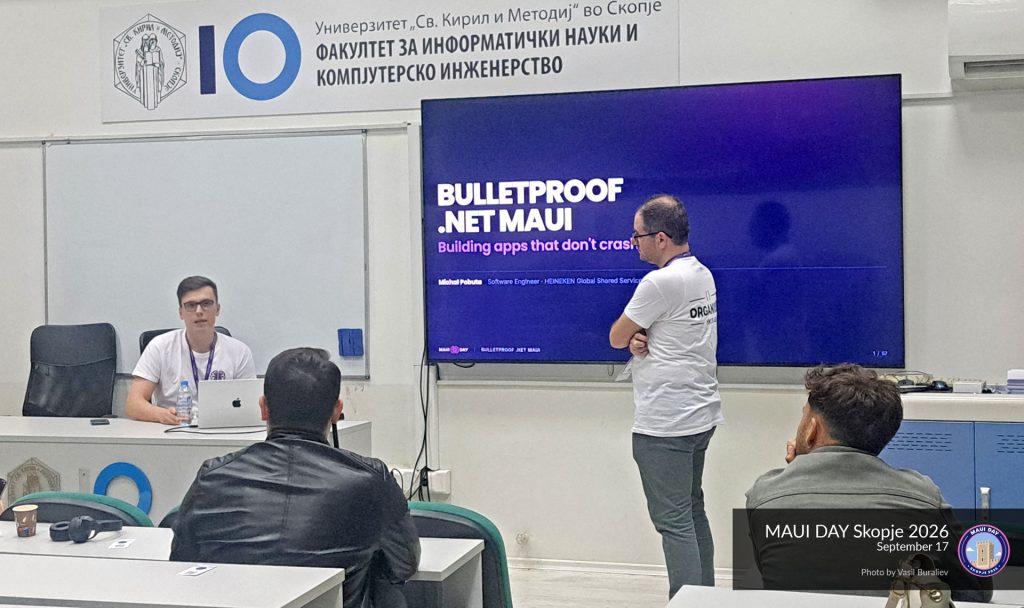
His session, “Bulletproof .NET MAUI: Building Apps That Don’t Crash,” covered the problems that appear when software leaves demonstrations and enters users’ hands: unhandled exceptions, async/await mistakes, Android ANRs, blocked UI threads, memory leaks, race conditions, lifecycle problems, Crashlytics and Sentry, trimming, and AOT-related differences between Debug and Release builds.
I liked this session. Not just because of the subject, although it was practical and relevant, but because Michał was an excellent presenter. His advice came across as experience rather than theory. That matters even more when you consider when he spoke.
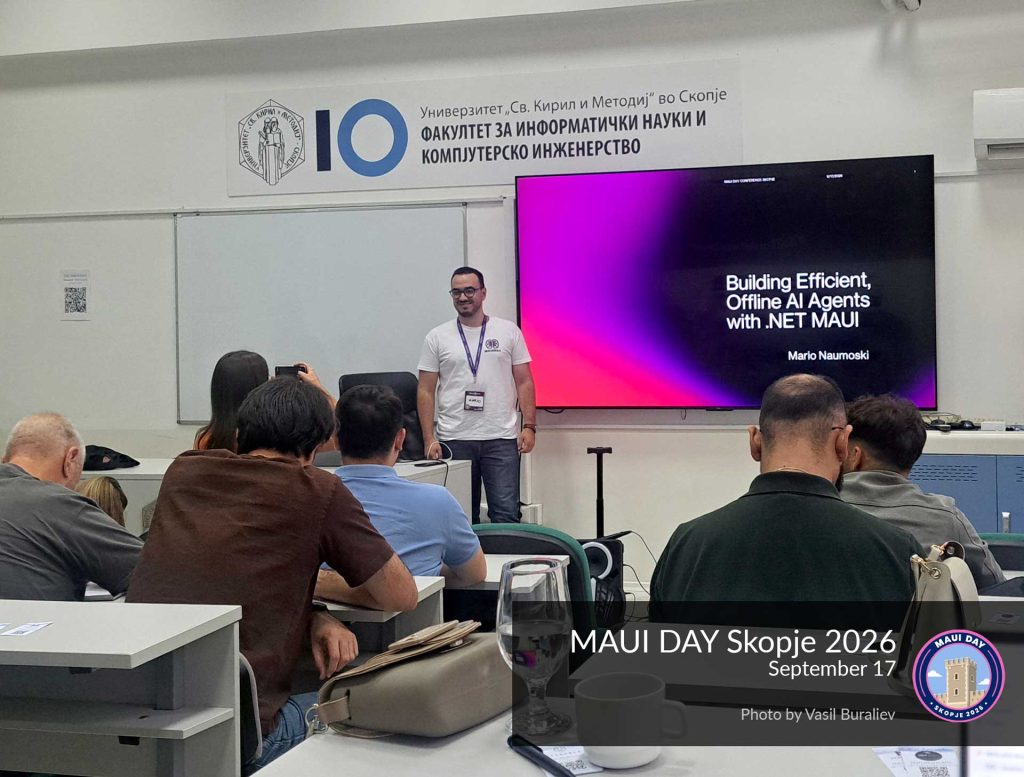
It was around 19:00. I had been at the event since the morning. After hours of technical presentations, coffee, discussions, and information, my attention should have been difficult to hold. He held it.
When the session finished, I went over and congratulated him personally. For me, his presentation also provided a useful counterweight to some of the more forward-looking parts of the day.
Frameworks evolve. AI changes workflows. Tooling becomes more sophisticated. But software still has to survive production.
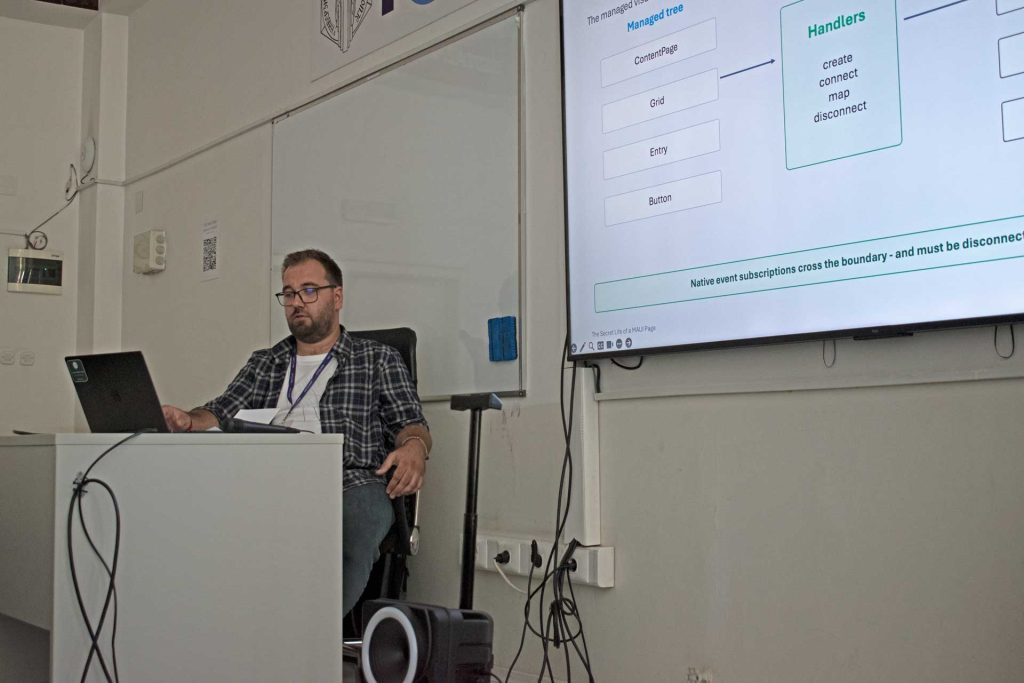
I can tightly connect Michal’s session with the one held by Mihail Mladenov – “The Secret life of a MAUI Page,” AKA “Page is not only a Page” that focused on keeping the app healthy and free of memory leaks. That was another great session at the event.
The Part of Remote Work That Technology Hasn’t Replaced
By the end of the day, however, I found myself thinking about something that had surprisingly little to do with .NET MAUI.
For roughly ten years, I have mostly worked as a freelancer from my own office. That does not mean working without people. Quite the opposite. I speak with clients, developers, managers, and international teams every day. Modern remote work makes collaboration across countries almost normal.
But there is a difference between communicating with people all day and being physically among them. You lose small things.
The conversation while taking coffee. Someone sitting down next to you before a presentation.
A discussion that begins with MAUI and somehow ends with freelancing. The possibility of grabbing a beer after work without scheduling a call two weeks in advance, which is a pity I didn’t take after the conference with part of the attendees and organizers who left the tech campus and moved to Lira restaurant.
Remote work solved geography extraordinarily well. It did not completely solve presence.
Standing at INNOFEIT that morning and talking with Vlatko, Ilija, Tony, Yevgeny Sotnikov, Michal, and other people from the community reminded me of something I had probably underestimated. I had missed this.
During the years I coded professionally, and later as a co-founder and IT director of Reaktiv (between 2006 and 2013), participation in the developer community was much more naturally woven into my professional life. MAUI Day briefly brought that feeling back. That was probably the most refreshing part of the event.
Skopje and the Strange Nature of Hidden Gems
The experience reminded me of another completely different industry.
At PIN Music Conference 10 in 2023, I had a similar feeling while covering the event from the music side of my work. People with serious international music-industry experience could be sitting in MKC in Skopje, sometimes in front of surprisingly modest audiences. One of the people who appeared at that edition was Dukagjin Lipa, the father of Dua Lipa and an established figure in the regional music ecosystem.
The point is not to compare software engineers with pop stars. It is the situation that feels familiar. Sometimes globally relevant people are right here, accessible in Skopje, and the opportunity receives less local attention than you might expect. MAUI Day felt like another example.
Having people such as Gerald Versluis and Stéphane Delcroix in a room with perhaps a few dozen developers is not a weakness of an event. It is an opportunity.
Technology Matters. People Make the Event.
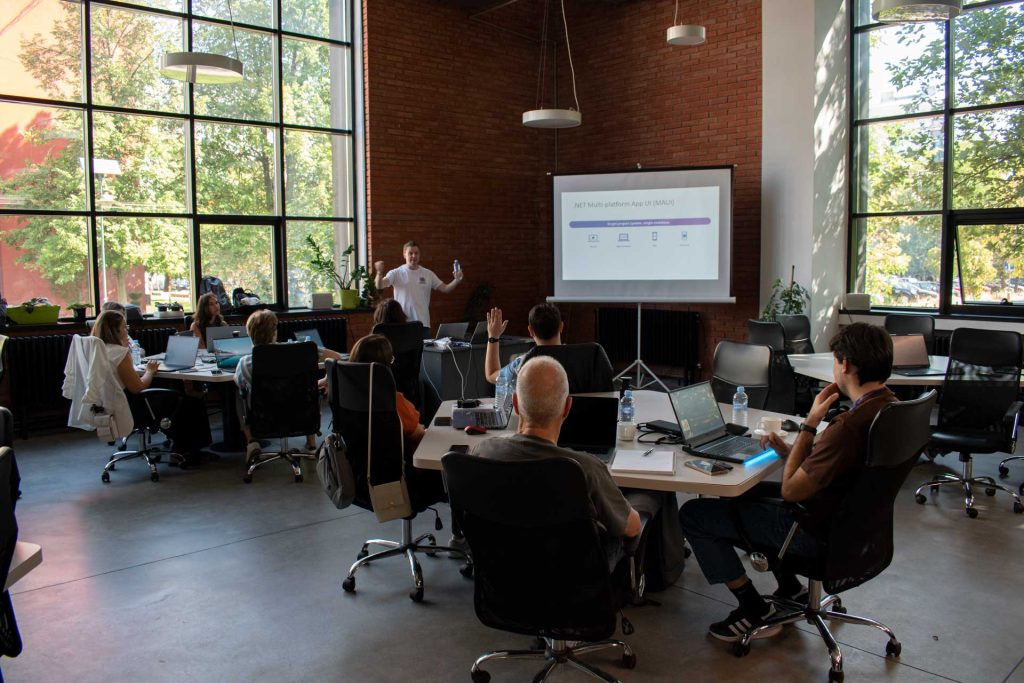
Events like this do not happen simply because speakers buy plane tickets.
Vlatko Tasevski and Ilija Rushkovski deserve particular recognition from my own experience of the day, as does Tony Edwards. They were welcoming, engaged with attendees, and clearly invested in making the event work. They were not alone; other people contributed to the organization as well, including supporters such as the Macedonian .NET Community and sponsors.
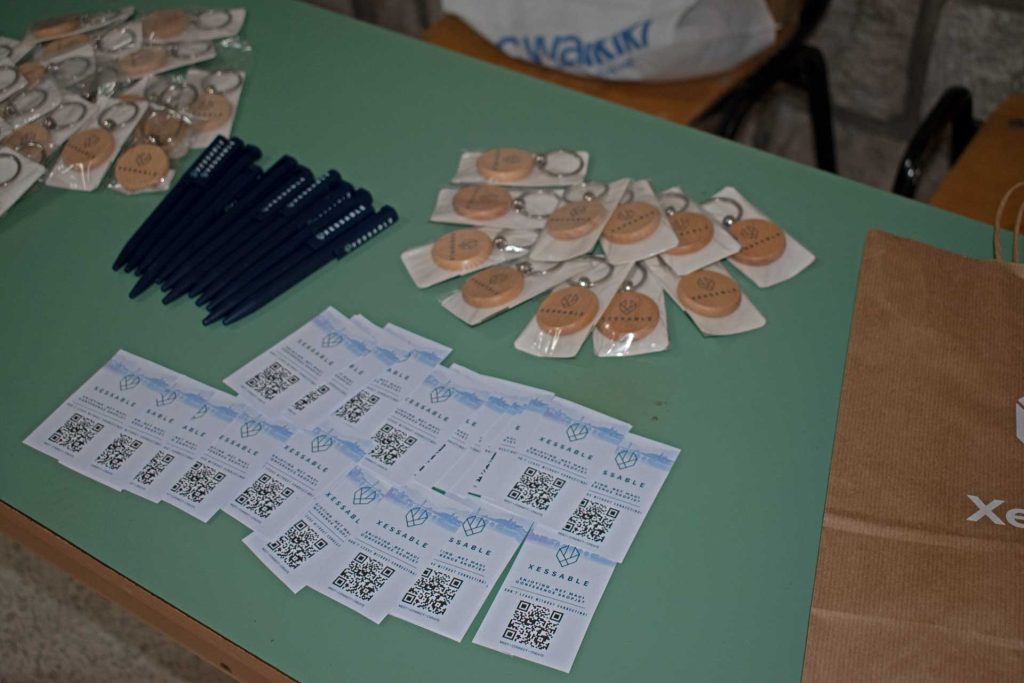
The broader WhatTheStack conference is organized by DeveD, Base42, and Angular Macedonia, and its 2026 edition expanded into an entire week of developer activities across Skopje.
Communities exist because somebody decides that organizing one more meetup, workshop, conference day, speaker trip, coffee table, or badge is worth the effort.
Usually, most attendees never see how much work sits behind that. They should.
I Went Home Tired – and Refreshed
By around 20:00, after more than ten hours around the event, I was finished.
Some of the organizers, speakers, and attendees continued the evening together at Lira. Under other circumstances, I probably would have joined them.
This time I went home. It had been a very busy period for me, and I was simply too tired. But tired was not the only thing I felt. I went to MAUI Day because OpenSilver gave me a professional reason to mingle with the .NET MAUI community and learn what’s new.
I came away with useful technical ideas about XAML, .NET 11, production reliability, AI-assisted development, and the changing feedback loop between developers, agents, and running software.
But I also came away thinking about something much older than any of those technologies. Community.
There is tremendous value in GitHub, Teams, Slack, Zoom, remote work, distributed engineering, AI agents, and all the tools that allow us to build software without sharing the same physical space.
Yet sometimes the most useful thing a developer can do is still very simple: Go somewhere. Sit in the room. Listen. Talk to people. And participate.
We recommend a series of articles about the AI Workflow created by Dimitar Grozdanovski.


Be the first to comment