Introduction
Artificial Intelligence (AI) is transforming industries, heck, the way how we consume the technology, search the web, work, make mistakes and seek guidance. In light of that, architecting AI workloads became a new discipline. One that thrives these days.
With that said, keep in mind that we are talking about non-deterministic behavior. This means that the algorithm can yield different results on different executions, with the same input. Unlike deterministic algorithms, nondeterministic ones may produce varying outcomes depending on execution paths.
Brief history of time:
- 1917: Pocklington’s randomized algorithm for modular square roots.
- 1930s – 1950s: Monte Carlo methods pioneered by Fermi and Los Alamos scientists.
- 1959: Rabin & Scott introduced Nondeterministic Finite Automata (NFA), showing equivalence with Deterministic Finite Automata (DFA).
- 1967: Robert W. Floyd used the term “nondeterministic algorithm” in flowchart-based formalization.
Building AI solutions requires more than just powerful models. It demands a structured approach to architecture of the AI workloads. This process is quite different from the ones we might already know and use. With this blog series, I will try to answer some of the questions, dilemmas and share my insights.
AI Workload
So what is an AI workload then? Well, it depends. 🙂 Fist, the term ‘workload’, introduced in the context of the Well-Architected Framework for Azure, stands for collection of application resources, data and any supporting infrastructure that function together towards a same business goal.
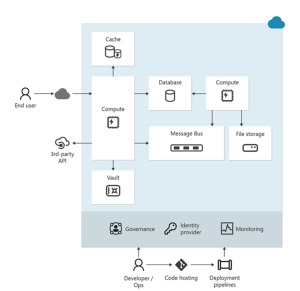
The same definition applies to AI workloads as well, with minor tweaks and differences of the components. 🙂
If we use machine learning to autonomously create new content, then we are talking about Generative AI (or GenAI). There are thousands of models, that can be customized, with our data, to produce articles, stories and art. These mimic human conversational languages, and are ideal for chat and natural language experiences.
Key word here being ‘mimic‘!
When we use explicit programing to perform a specific set of tasks, based on rules and algorithms, we are talking about Discriminative AI. They are used for predictive analysis, recommendations and fraud detection. They are divided into:
- Model-based: systems that find patterns based on training (from prior observations). They can’t create new content or adapt on their own.
- Non-model based: autonomous agents that follow predetermined rules to interact (i.e. characters in games).
You should spend some time thinking whether to buy or build. If generic responses are what you are looking for, then prebuilt model or AI service-based solution will work. For anything else, custom model, trained on data specific to the business and/or compliance needs.
Creating and maintaining own models require lot of resources, time and expertise.
Relevant Frameworks
We start with the Clod Adoption Framework. It is a comprehensive set of guidance, best practices, and tools designed to help organizations plan, implement, and manage their cloud adoption journey on Azure. It covers strategy, governance, security, operational excellence and responsible IA principles, ensuring a structured and successful migration or modernization process.

Additional links:
Cloud adoption in the era of accelerated Digital Transformation (ITuziast)
Clod Adoption Framework – AI adoption (Microsoft Learn)
The Well-Architected Framework provides a set of principles and practices for designing and optimizing workloads on Azure. It focuses on five key pillars: Cost Optimization, Operational Excellence, Performance Efficiency, Reliability, and Security. It helps organizations build their cloud workloads.
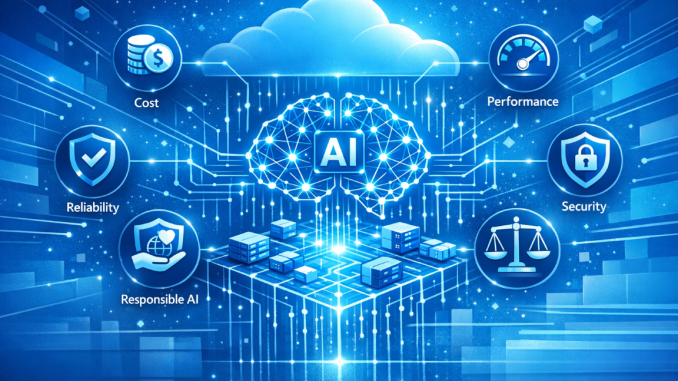
The one we are looking for our scenario is Azure Well-Architected Framework for AI. It provides best practices to help you design and operate AI workloads. It builds on the five, already existing pillars plus one specific to AI workloads:
- Cost Optimization
- Operational Excellence
- Performance Efficiency
- Reliability
- Security
- Responsible AI
Architectures and tools
AI architecture design center provides reference architectures, guidance, and tools for designing and deploying AI workloads on Microsoft Azure. These best practices and patterns help you design cloud solutions and choose the right technology. Above all, covers various scenarios, such as Machine Learning, Deep Learning, AutoML, and Generative AI.
Microsoft Foundry (Platform, Tools & Services) serves as the unified hub for building, evaluating, and operationalizing AI workloads. To clarify, this is especially relevant for Generative AI and LLM‑powered applications. Azure’s developer ecosystem provides deep integration with AI services, ensuring developers can build, test, deploy, and optimize AI applications efficiently. This includes:
- Core Developer Tools (Visual Studio, GitHub, Azure Dev CLI)
- Frameworks & Runtime Environments (Kubernetes, Container Apps, Azure Functions)
- Integrated Model & Data Tooling (Azure ML, Microsoft Fabric, various vector-enabled databases)
The Well-Architected Framework AI workload assessment helps the teams evaluate key technical design areas and provides recommendations for improving.

This guided assessment evaluates your workload across all six pillars and identifies:
- Remediation actions
- Gaps
- Risks
- Optimization opportunities
Why all of this matters?
Systems based or infused with AI capabilities, evolve with data and business needs. Without a structured approach, organizations put themselves in risk. It can be related to uncontrolled costs, operational issues, security holes, and ethical dilemmas.
While we go trough the pillars, we will discuss various design decisions, their importance, and share some tips along the way.



Be the first to comment