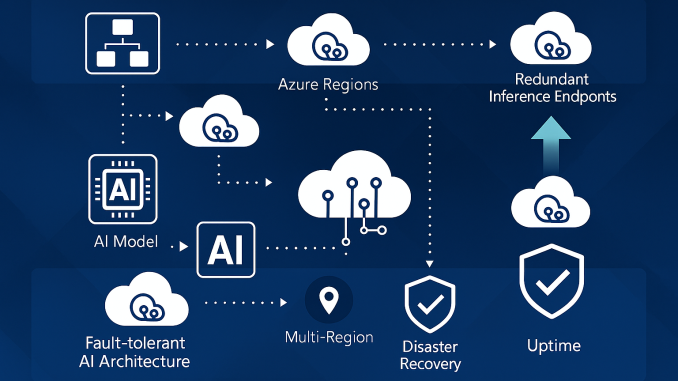
Introduction
Reliability in AI workloads goes far beyond traditional application resilience. In these systems, reliability must account not only for infrastructure uptime but also for model stability, data continuity, and the operational consistency of complex pipelines.
Furthermore, they behave differently under failure. For example, a dropped data pipeline can silently degrade a model, a corrupted feature store can invalidate predictions, and a minor drift in input data patterns can erode model accuracy without causing any visible system errors.
Therefore, designing for reliability requires a holistic approach. An approach, that covers resilience across compute, storage, orchestration, training, and inference. This helps ensuring that the model’s predictions remain trustworthy over time.
This post explores how to architect reliable AI systems on Azure using proven patterns and best practices aligned to the Well‑Architected Framework.
Check out the other parts in this series:
Part 1 where we introduced the Azure Well-Architected pillars for AI workloads/systems.
Part 2 where we examined Responsible AI principles.
Part 3 where we talked about operational excellence.
Part 4 where the topic of performance efficiency
Designing fault‑tolerant AI systems
Keep in mind that AI systems, are inherently distributed systems. Well ,that makes sense, since Microsoft Azure is highly distributed service itself. Training jobs run across clusters of compute nodes, pipelines span trough multiple orchestrators, and inference endpoints often rely on multiple dependent services. Because of this distributed nature, a fault in one AI workload component can quickly cascade to others unless the architecture is designed to absorb failures.
Fault tolerance starts with using managed, self-healing compute. Services like Azure Machine Learning managed compute clusters and Azure Kubernetes Service for AI workloads, automatically recover from node failures, reschedule workloads, and scale out based on demand.
For long-running training jobs, automated retry logic is critical. Training jobs should be designed to checkpoint progress frequently so they can resume from intermediate states rather than restarting from scratch.
For inference workloads, reliability is achieved by hosting models in replicated environments where multiple instances can handle traffic concurrently.
Autoscaling should be configured based on relevant metrics such as latency, GPU utilization, or queue depth rather than CPU load. This is inline with AI workloads, since they behave differently than traditional applications. Adding a fallback mechanism (such as a simplified or cached model) is considered a best practice when the primary inference endpoint becomes temporarily unavailable.
Best practices:
• Use managed compute clusters that provide automatic healing and scale-out.
• Implement checkpoints for long training jobs to support option to resume.
• Run inference endpoints with at least two replicas to avoid single-point failures.
• Configure autoscaling using metrics tailored to AI workloads (latency, GPU utilization).
• Use retry policies, exponential back-off, and circuit breakers around dependent services.
Handling model drift and data pipeline failures
A system can be ‘up’ but still unreliable if the quality of its predictions deteriorates. This makes monitoring for model drift and data anomalies fundamental to AI systems reliability.
Model drift occurs when the statistical distribution of input data changes from that of the training dataset. Even subtle shifts in user behavior, seasonality, market context, or product changes can cause model performance to degrade silently.
Azure Machine Learning provides tools for monitoring model inputs, outputs, and associated metrics to detect drift over time. Once drift is detected, organizations should have automated or semi‑automated retraining pipelines ready to regenerate and redeploy updated models.
Data pipelines represent another major reliability risk. If data ingestion breaks or produces malformed data, downstream models can behave unpredictably. Implementing validation layers, schema enforcement, and data-level quality checks ensures that bad data is caught early. Using systems like Delta Lake with ACID transactions prevents corruption and makes rollback possible.
Best practices:
• Enable continuous monitoring of model performance, feature distributions, and prediction quality.
• Configure data drift detection using Azure ML’s built-in monitoring capabilities.
• Establish automated retraining pipelines triggered by drift thresholds or data freshness requirements.
• Use transactional storage like Azure Databricks Delta Lake to avoid corrupted or partial data reads.
• Integrate data validation frameworks to catch anomalies before they reach the model.
Disaster Recovery and Business Continuity for AI systems
Disaster recovery (DR) for AI workloads requires a broader scope than traditional DR planning. One reason being, that it includes not only the infrastructure, but also the state of the ML system. Models, feature stores, experiment metadata, lineage records, environment definitions, and datasets all constitute critical assets that must be recoverable across regions.
A robust DR strategy replicates model artifacts and registries across regions using Azure ML registries with geo-redundancy. Data used in training or inference should be stored in geo-redundant or region-paired storage configurations.
For the operational environment, infrastructure-as-code (IaC) ensures that compute clusters, networking, policies, and pipelines can be recreated consistently in secondary regions.
Failover testing should be conducted regularly because AI systems often have interdependent components that behave differently under simulated failure.
Inference systems require special consideration: an AI outage can significantly impact front-line services. A common best practice is to maintain warm standby inference clusters in a paired region and to replicate model versions, environments, and deployment configurations, so failover can occur with minimal delay.
Best Practices
• Store all models, datasets, and pipeline metadata in geo-redundant storage.
• Use infrastructure-as-code for recreating AI environments consistently.
• Configure Azure ML registries for multi-region model replication.
• Maintain warm standby inference endpoints in paired regions.
• Test failover regularly to ensure all dependencies work end-to-end during DR.
The relationship between Reliability and Responsible AI
Reliability and Responsible AI are tightly connected. A reliable system not only stays online but also provides consistent, safe, and explainable outputs. Sudden drops in accuracy, unexplainable behavior, or inconsistent predictions can appear as reliability failures even when systems are technically healthy.
Using tools such as the Azure ML Responsible AI dashboard helps maintain reliability by surfacing anomalies in model behavior, bias patterns, or unintended effects. These tools complement reliability monitoring by ensuring that the model’s integrity and fairness remain stable throughout its lifecycle.
Summary
Reliable AI workloads require more than redundant infrastructure. They need resilient pipelines, drift-aware monitoring, reproducible training processes, and robust disaster recovery planning. Azure provides the tools and frameworks to support reliability across the entire AI lifecycle.
As it turns out, reliability ultimately depends on workload architecture with failure in mind. This means anticipating not just when the system will fail, but how the model and data will behave when it does.
An Reliable AI workload remains available, consistent, and trustworthy over time. As a result, it is enabling organizations to confidently scale AI into production environments where stability is critical.




Be the first to comment