Introduction
Security is one of the most critical pillars of the Azure Well‑Architected Framework, and with AI workloads, the security landscape becomes even more complex. Unlike traditional applications, AI systems manage sensitive data, context-rich features, and high‑value models that may encode intellectual property or business logic.

They also involve distributed training jobs, complex pipelines, multi-tier inference architectures, and often external integrations. Each of these layers introduces potential security vulnerabilities if not carefully protected.
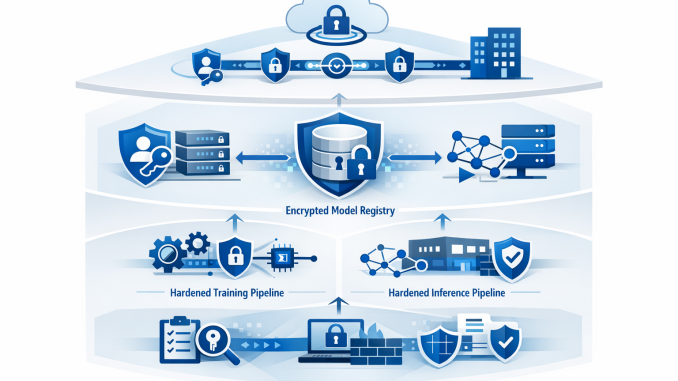
Security for AI systems is not just a matter of perimeter defense. It requires a holistic, multi-layered approach that incorporates data protection, identity governance, model safeguarding, pipeline hardening, continuous monitoring, and compliance alignment.
Trade-off:
Implementing the highest levels of security incurs trade-offs in cost and accuracy because the ability to analyze, inspect, or log the encrypted data is limited. Content safety checks and achieving explainability can also be challenging in highly secured environments.
This post provides an look at how to build secure, enterprise-grade AI workloads on Azure, combining best practices with Azure-native tools and Responsible AI considerations.
Check out the other parts in this series:
Part 1 where we introduced the Azure Well-Architected pillars for AI workloads/systems.
Part 2 where we examined Responsible AI principles.
Part 3 where we talked about operational excellence.
Part 4 where the topic of performance efficiency.
Part 5 where we talked about reliability.
Securing data and models across the AI workloads
AI workloads depend on large volumes of data (structured, unstructured, streaming, or real-time), often containing personal, confidential, and/or regulated information. Protecting that data while enabling productive AI model development requires applying Zero Trust principles throughout the lifecycle.
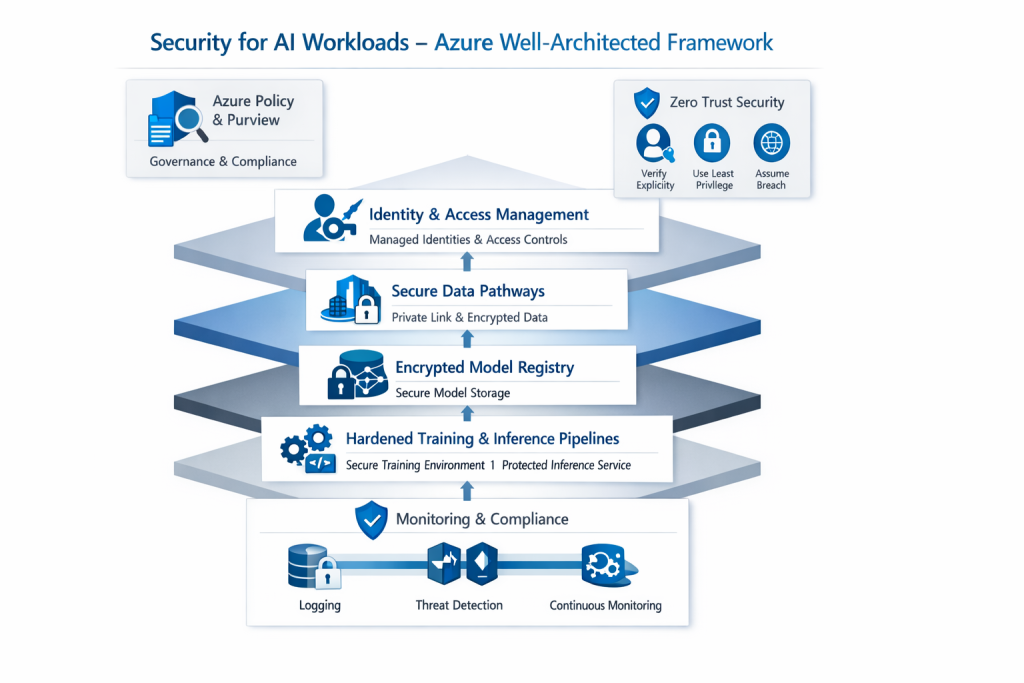
Securing data starts at ingestion point. All data entering your AI workloads must be encrypted by default, both at rest and in transit. Services such as Azure Storage, Azure SQL, Azure Data Lake Storage (Gen2), and Cosmos DB provide encryption. But, any sensitive workloads benefit from customer-managed or HSM-backed keys in Azure Key Vault. This is aimed at achieving highest level of cryptographic protection of the data itself. Enforcing private endpoints eliminates exposure of data services to the public internet, while firewall rules and VNET integration ensure data paths remain fully internal.
The approach, as per the best practices is to build an AI Landing Zone with Platform Landing Zone. This reference architecture model enables future expansions, support for various (AI and/or non-AI) workloads as well. There is still an option to deploy it as standalone application landing zone.

Note:
A Platform Landing Zone provides shared services (identity, connectivity, management) to applications in application landing zones. Consolidating these shared services often improves operational efficiency.
Model assets deserve equal protection. AI models increasingly represent competitive advantage and business-critical intellectual property. Azure Machine Learning model registries with appropriate role-based access controls (RBAC) and encrypted artifact storage ensure that only authorized roles can access or deploy models. In light of the recent geo-political turmoil, sovereignty of the data becomes even more important. As a result of that, Azure Confidential Computing, with focus on building Confidential AI workloads support several scenarios, covering the entire AI lifecycle.
Best practices:
• Use Private Endpoints by default for all data stores connected to AI workloads.
• Protect model artifacts using Azure ML registry, RBAC, Key Vault-backed encryption.
• Leverage Azure Confidential Computing for highly sensitive data processing.
• Apply network segmentation to isolate training, staging, and production inference.
• Enforce strong key management practices using Key Vault and Azure Policy.
Identity, access management, and securing AI pipelines
AI pipelines include multiple components, such as data ingestion, feature engineering, model training, evaluation, approval workflows, deployment, and monitoring. Each stage introduces identities, credentials, agents, and permissions that must be managed tightly to prevent unauthorized access or tampering.
Azure recommends a Zero Trust approach based on identity verification, least privilege, and continuous evaluation. Managed Identities should be the default mechanism for identity handling in all Azure ML jobs, Data Factory pipelines, GitHub Actions/DevOps pipelines, and AKS deployments. This eliminates secret sprawl and removes the need to store credentials in repositories or configuration files.
Role-based access control (RBAC) should be carefully mapped to each persona: a data scientist should not automatically have permission to deploy production models, just as an MLOps engineer should not need full read access to sensitive raw datasets. If possible, implementing Conditional Access policies adds another layer of protection. This is done by requiring MFA, compliant devices, or network conditions before accessing Azure ML Studio or model registries.
Securing training pipelines includes isolating compute clusters, ensuring workloads run in secured sub-nets, enforcing code-signing for deployment artifacts, scanning containers for vulnerabilities, and using private container registries. CI/CD pipelines should be hardened through branch protection, environment approvals, and required reviewers to prevent unauthorized model modifications or deployments.
Best practices:
• Replace all secrets with User-assigned Managed Identities.
• Apply strict RBAC mapping to all the AI workloads personas.
• Use capabilities of GitHub Advanced Security or Azure DevOps security scanning for ML codebases.
• Harden pipeline triggers using approvals, branch protection, and signed artifacts.
• Use Private Link for all services that are part of the AI workloads (i.e. Azure ML, Azure Container Registries, Azure Kubernetes Services, and storage services).
Compliance, Governance, and Responsible AI controls
AI systems must comply not only with traditional cloud security and governance requirements but also with sector-specific regulations like GDPR, HIPAA, PCI-DSS, ISO 27001, or even upcoming AI-specific frameworks such as the EU AI Act. Azure provides tools for governance, auditing, classification, and compliance validation to ensure AI workloads remain aligned with regulatory expectations.
Note:
Microsoft announced the Microsoft Security Dashboard for AI (Preview) few days ago. We will circle back and do a review on it soon.
Azure Policy is essential for enforcing standards across your AI systems. Policies can require Private Link for model endpoints, ensure encryption settings, enforce tagging for cost and governance, block creation of publicly accessible storage accounts, or restrict cluster types that don’t meet security requirements.
For AI-specific governance, Microsoft Purview adds value by classifying data, tracking lineage across ingestion and transformation, and assessing compliance risk.

Responsible AI is an important extension of the security pillar because it enhances the trustworthiness and safety of model outputs. Azure ML’s Responsible AI tooling, like interoperability dashboards, fairness reports, and error analysis. This helps ensure models behave consistently and ethically. By monitoring model behavior as part of the security and governance strategy, organizations can detect unintended outcomes early and reduce reputational or regulatory risks.
Best Practices
• Use Azure Policy to enforce organizational security and compliance requirements.
• Enable Purview for data classification, lineage tracking, and regulatory mapping.
• Integrate Responsible AI dashboards into the model validation and approval process.
• Maintain full audit logs for dataset versions, feature transformations, and deployments.
• Use Defender for Cloud to provide real-time security posture management.
Summary
Security for AI workloads is an end-to-end discipline that spans data protection, identity governance, pipeline hardening, model security, and compliance. Azure provides a comprehensive set of tools, including Key Vault, Azure ML, Private Link, Azure Policy, Defender for Cloud, Microsoft Purview, and Confidential Computing. They are all aimed at enabling organizations to build secure and responsible AI systems at scale.
But, technology alone isn’t enough. AI security requires intentional architectural design, close collaboration between data science and security teams, and a strong grounding in governance and Responsible AI principles. When done properly, the result is an AI system that is not only secure but also resilient, trustworthy, and aligned with enterprise and regulatory expectations.




Be the first to comment